Architectural Plug-In Explorative Machine for the Sonic Recomposition of Space
Research stage: intermediate doctoral stage
Category: Artefact
Context
The human use of electromagnetic energy as carrier of information (that is, signal processing – from early electric telecommunication and radio to global computing networks) changes and complicates the relationships between bodies, media technologies, and lived environment. Transmission with the speed of light brought about a shifting sense of space and time. Ubiquitous computing changes the modes of governance. The increasing dependency on media technologies to carry out or automate activities (to sense, build, and change our environment) and the interdependencies between them, coupled with the decreasing clarity of their inner workings, which is in part inherent in their expanding complexity, creates unprecedented forms of automation and control. In the context of the concrete entanglement between bodies, media technologies, and lived environment, or abstract space-time and social realities, how could we address the problem of automated subservience and ubiquitous control in order to recuperate the recognition of the right, or responsibility, to actively engage in the making of our habitat? And how to develop the means to do so?
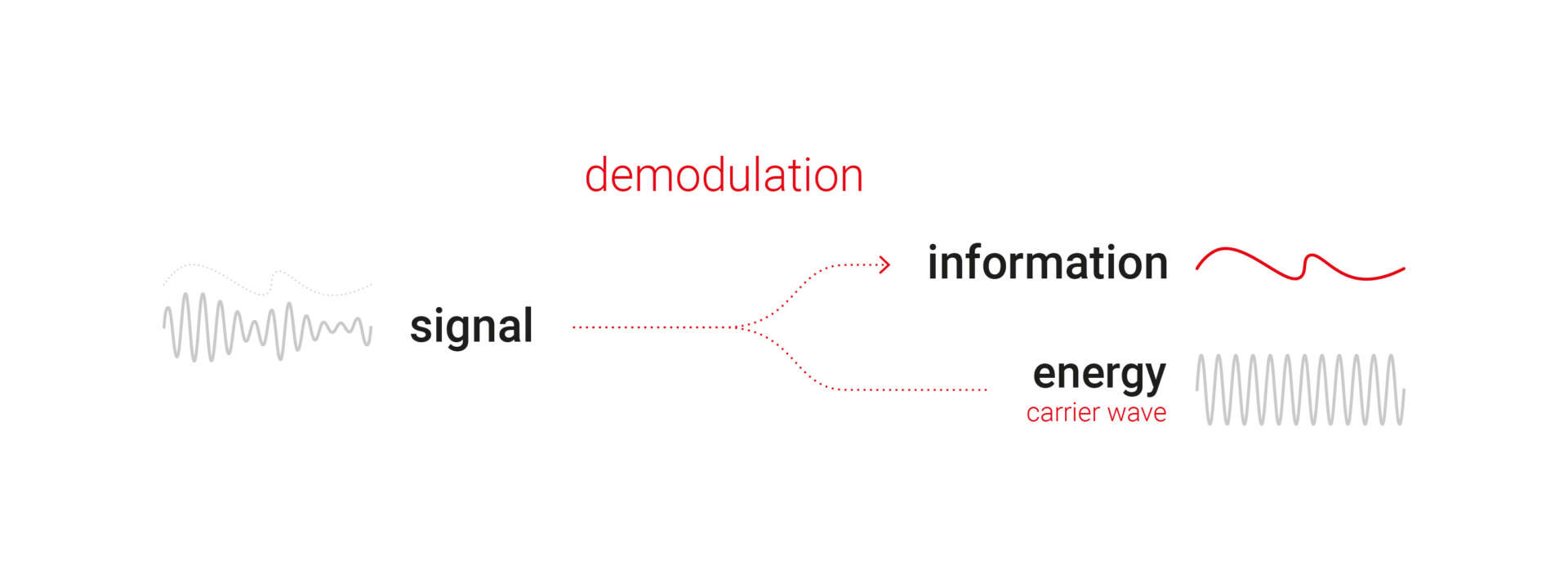
There are many ways to approach this problem and there is a vast body of work in this domain, across various disciplinary fields. My research is transdisciplinary and combines a theoretical and design-driven path at the intersections of architecture, sonic practice, sound studies, and the philosophy of technology. It focuses specifically on sound and signal processing in spatial practice, which enables a process-based and diagrammatic way of thinking and making to explore the inner workings of media technologies in relation to bodies and lived environment. A signal in its most basic form can be understood as carrier of information transmitted through a medium. The information is impressed into a carrier wave (electromagnetic energy) through the process of modulation. [ 1 ] A received signal, in turn, needs to be demodulated (or decoded in digital terms) to retrieve the information, which is precisely what complicates technological mediation.

Figure 1: Signal graph (image by author).
Explorative machine
In design-driven research the diagram is a means to explore, expose, and design processes of technological mediation. Furthermore, diagramming is understood here as a material-discursive process, which implies both meaning and matter, epistemology and ontology, and is performative. This lies at the core of both the theoretical and design-driven research methodology.
In turn, the realisation of a series of site-specific sound installations is a way to put the diagram into operation, to spatially articulate these processes and produce new configurations. Employing the capacities of sound and signal processing in spatial design allows for producing spatio-temporal manifestations in a dynamic, instant, and real-but-abstract way, articulating abstract relationships and operations such as algorithmic processes sonically and spatially.
Through the series of installations, the research seeks to develop an abstract machine in order to enable processes of reterritorialisation by modifying existing sites sonically. Each project modifies a sonic space, exploring other forms for or latent potentials of that given space by rerouting its circuits and producing new material configurations and spatial articulations of sound. This involves real-time signal processing. The architectural machine is itself composed of multiple machines, and learns to adapt to and intervene in different environments. Through an iterative process of deterritorialisation and reterritorialisation, which involves various sites, it is conceived, constructed and effectuated.
Installation
The site-specific sound installation is situated in the servant space between tribune and presentation room. [ 2 ] It is a machine that is as if it were plugged into the physical space by means of electroacoustic transducers. Ambient noises and structure-borne vibrations are picked up by means of (piezoelectric) contact microphones. [ 3 ] The resulting audio signals are processed in real-time and spatially redistributed to loudspeakers placed behind three wall openings. The audio signals are not only treated as sound material but their properties (intensities, densities, envelopes, frequencies) are also sensed to trigger and modulate stochastic processes, articulating the machine’s inner workings. Short extracted waveforms generate new sounds that follow the textures of and respond to the input signals. The acoustic environment and generative processes cross-modulate and mutually affect one another in a continuous re-composition.

Figure 2: Installation (image by author)

Figure 3: Set up (images by author)
The installation deliberately disorients the listener – it modifies perception through the spatial redistribution of sound. In doing so the installation implicitly directs attention to broader questions regarding the shifting sense of space-time.
The work aims to contribute to exploring possibilities for another space, another thinking, which moves beyond the inevitability of subservience to the dominant mode of subjectivation, without slipping into binary opposition or, on the contrary, postmodern, depoliticised and uncritical relativism. The social relevance, or urgency, lies in the aforementioned problem of automated subservience and ubiquitous control inherent in the concrete entanglement between bodies, media technologies, and lived environment. It is needed to understand this entanglement as continuous and reciprocal process of formation.

Figure 4: Research context (image by author)

Figure 5: Theoretical framework (image by author)